Your Filter Part Is Not a Consumable. It Is a Line of Defense.
Western Separations™ Resource Series
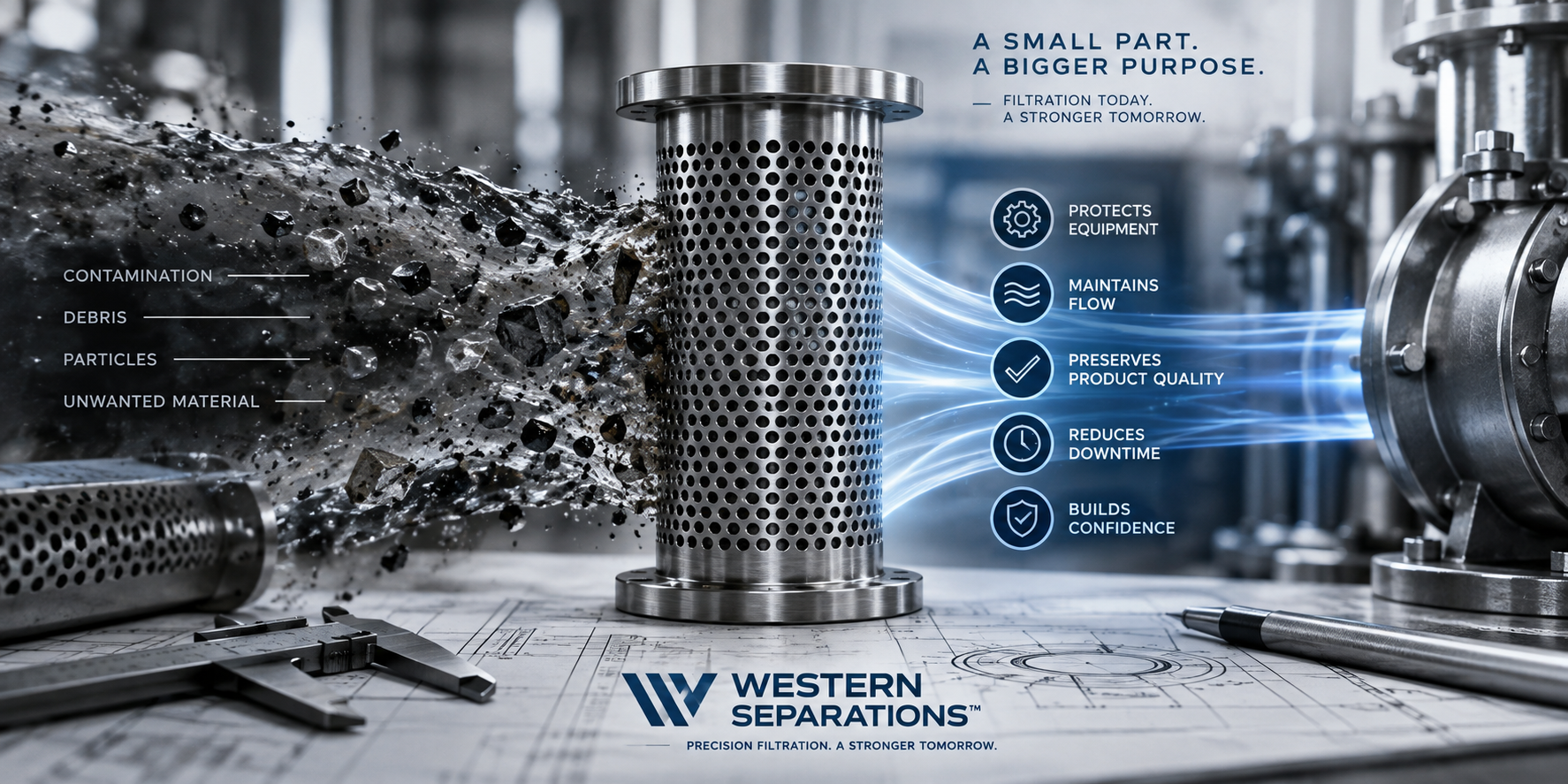
A filtration or separation component is not just a small part. It may be protecting your equipment, flow, product quality, uptime, and confidence. Learn why custom screens, baskets, filter elements, and perforated tubes should be treated as critical lines of defense in your operation.
Why the right filtration and separation component protects more than the process — it protects your equipment, uptime, quality, and peace of mind.
Some parts get treated like small purchases.
A screen.
A basket.
A filter element.
A perforated tube.
A strainer.
A mesh component.
A small stainless part inside a larger system.
It gets cleaned.
It gets reused.
It gets replaced.
It gets ordered when needed.
And because it may be smaller than the pump, vessel, line, machine, or control system around it, it can be easy to think of it as just another consumable.
But that may be the wrong way to look at it.
A filtration or separation component is not just a part.
It is a line of defense.
It may be protecting your pump.
It may be protecting your valves.
It may be protecting your analyzer.
It may be protecting your product quality.
It may be protecting your operators from unnecessary maintenance issues.
It may be protecting your schedule from unplanned downtime.
It may be protecting your customer from a bad batch, delay, or performance problem.
That small part may be doing more work than anyone gives it credit for.
At Western Separations™, we help companies source, duplicate, and manufacture custom filtration and separation components built around real process needs.
But before we talk about parts, let’s talk about protection.
Because when you see the part differently, you manage it differently.
And when you manage it differently, your operation gets stronger.
The Small Part Before the Expensive Problem
In many industrial systems, filtration and separation components sit quietly between a problem and something expensive.
A strainer may sit before a pump.
A screen may sit before a valve.
A filter element may sit before an analyzer.
A basket may collect debris before it travels downstream.
A perforated tube may support flow, media, or separation inside a process.
A custom metal component may hold the whole function together.
When the part is working, nobody notices.
The process flows.
The pump runs.
The equipment stays protected.
The maintenance schedule stays manageable.
The product stays consistent.
The team moves on.
But when that part is wrong, worn, clogged, missing, cracked, corroded, or poorly matched, the problem rarely stays small.
It travels.
A bad screen can become debris downstream.
A poor fit can become bypass.
A clogged element can become pressure drop.
A weak basket can become failure under service.
The wrong material can become corrosion.
A missing spare can become downtime.
A “close enough” replacement can become repeated maintenance.
That is the hidden truth:
The cost of the part is not the same as the cost of the problem it prevents.
That is why the right component matters.
The Light Bulb: Filtration Is Not Only About What You Remove
Most people think filtration is about removing something unwanted.
And it is.
Particles.
Debris.
Contamination.
Solids.
Moisture.
Unwanted material.
Process byproduct.
But that is only half the story.
Filtration is also about what you protect.
What are you protecting downstream?
A pump?
A valve?
A heat exchanger?
An analyzer?
A customer specification?
A product stream?
A batch?
A process line?
A critical piece of equipment?
A maintenance schedule?
A team’s ability to operate with confidence?
That question changes the conversation.
Instead of asking:
“What filter do we need?”
Ask:
“What are we protecting, and what happens if it is not protected?”
That is the better question.
Because once you know what is being protected, you can make a smarter decision about the component.
You can think about fit.
You can think about material.
You can think about open area.
You can think about flow.
You can think about cleanability.
You can think about failure history.
You can think about whether a standard part is enough or whether the application needs something custom.
The part is not just there to catch something.
It is there to defend something.
The Five Things Your Filtration Component May Be Protecting
A good filtration or separation component may protect more than one thing at once.
Here are five areas worth thinking through.
1. It Protects Equipment
This is often the most obvious role.
A strainer, screen, basket, or filter element may protect equipment from particles, debris, or unwanted material that could cause wear, clogging, scoring, sticking, or failure.
The protected equipment may include:
Pumps
Valves
Nozzles
Spray systems
Meters
Heat exchangers
Analyzers
Instruments
Hydraulic components
Process equipment
Downstream filtration stages
If the component fails to protect the equipment, the damage may show up somewhere else.
That is why a filtration part should not be judged only by its own condition.
Ask what it is guarding.
If a small part protects an expensive asset, it deserves more attention than its size suggests.
Question to ask:
What equipment depends on this component doing its job correctly?
2. It Protects Flow
Flow is easy to take for granted until it changes.
A component that is too restrictive may reduce flow.
A component that plugs too quickly may create pressure issues.
A component with too little open area may force the system to work harder.
A component with the wrong openings may fail to separate properly.
A component that is not built to the application may create inconsistent performance.
Flow problems can create confusion because they may not look like a part problem at first.
The team may see reduced output.
The pump may work harder.
The system may lose efficiency.
Operators may need to clean the part more often.
Maintenance may chase symptoms instead of the cause.
This is where design details matter.
Hole size matters.
Mesh size matters.
Open area matters.
Geometry matters.
Fit matters.
Material matters.
Cleanability matters.
The goal is not just to stop unwanted material.
The goal is to do that while allowing the process to keep moving.
Question to ask:
Is this component helping the process flow, or is it quietly becoming a restriction point?
3. It Protects Product Quality
In many industries, filtration and separation components help protect the product itself.
They may help keep unwanted material out of the product stream.
They may support consistency.
They may help maintain cleanliness.
They may help protect batch quality.
They may reduce contamination risk.
They may support downstream processing.
This matters in food and beverage, chemical processing, water and process systems, medical-related applications, industrial manufacturing, and other environments where the final product or process output must meet expectations.
A component that technically “fits” but does not perform correctly may create quality issues that are much more expensive than the component itself.
That is why the application matters.
What is the media?
What needs to be removed?
What is allowed to pass?
What particle size matters?
How is the part cleaned?
What happens if material gets through?
Is the part protecting a final product, an intermediate process, or downstream equipment?
Quality is not only controlled at the end.
Sometimes it is protected by small components along the way.
Question to ask:
What quality issue could appear if this component stopped doing its job?
4. It Protects Uptime
Downtime is not always caused by the biggest machine.
Sometimes downtime starts with the part nobody planned for.
A small component fails.
There is no spare.
The drawing is missing.
The part number does not work.
The supplier cannot help.
The equipment is old.
The standard catalog option does not fit.
The part has to be cleaned, repaired, modified, or improvised.
Now the line is waiting on a small component.
This is why hard-to-source filtration and separation parts should be treated with respect before they fail.
If a part can stop the process, it is not minor.
It is critical.
The best time to create a replacement path is before the emergency.
That may mean documenting the part, photographing it, measuring it, identifying the material, keeping a spare, or working with a custom component partner who can review the part from a sample, drawing, photo, CAD file, or worn component.
Question to ask:
If this part failed tomorrow, would we know exactly how to replace it?
5. It Protects Confidence
This may be the most overlooked benefit.
When teams know their critical parts are understood, documented, and supported, the operation feels different.
Maintenance is not guessing.
Purchasing is not starting from zero.
Engineering is not trying to reverse-engineer a mystery under pressure.
Operations is not waiting for answers.
Leadership is not wondering why a small component became a large problem.
Confidence matters.
A reliable filtration or separation component is not just a physical item.
It is part of a system of trust.
The team knows what the part does.
The team knows why it matters.
The team knows what information is needed.
The team knows who can help.
The team knows there is a path forward.
That confidence is valuable.
It reduces panic.
It improves planning.
It supports better maintenance.
It makes repeat orders easier.
It helps keep critical systems moving.
Question to ask:
Does our team have confidence in this part, or are we relying on hope?
The “Line of Defense” Test
Here is a simple test for any filtration or separation component in your operation.
Ask these questions:
What is this part protecting?
What happens if it fails?
What happens if it clogs?
What happens if it allows material to bypass?
What happens if it is made from the wrong material?
What happens if it cannot be replaced quickly?
What equipment is downstream?
What quality issue could appear?
What maintenance problem could repeat?
What would we do if the supplier could no longer provide it?
If those questions create concern, the component deserves a closer look.
It may be a small part.
But it may be protecting something much larger.
When “Good Enough” Becomes Expensive
There are times when an off-the-shelf replacement works perfectly.
There are also times when “close enough” becomes expensive.
A replacement screen that does not seal correctly may allow bypass.
A basket with the wrong dimensions may be difficult to install or remove.
A filter element with the wrong opening size may fail to protect downstream equipment.
A perforated tube with the wrong open area may restrict flow.
A material mismatch may lead to corrosion or early failure.
A weak construction detail may not survive cleaning, pressure, temperature, or vibration.
The danger is that the problem may not show up immediately.
The part may install.
The system may run.
Everything may look fine for a while.
Then the issue appears as a maintenance problem, performance problem, quality problem, or failure somewhere else.
That is why a custom part should be reviewed around the application, not just the dimensions.
Fit matters.
Flow matters.
Filtration matters.
Finish matters.
Failure history matters.
The right component is the one built for the job it has to do.
What Engineers and Maintenance Teams Should Ask Before Replacing a Filtration Component
Before replacing a custom or hard-to-source filtration component, ask better questions.
Not just:
“Can someone make this?”
Ask:
What is this component protecting?
What flows through it?
What does it need to catch, separate, support, or control?
What happens downstream if it performs poorly?
What material does the environment require?
Is the current part failing for a reason?
Is the replacement expected to be cleaned and reused?
Does the component need to survive pressure, temperature, corrosion, abrasion, or vibration?
Is the part standard, modified, obsolete, or fully custom?
Do we need one replacement, a spare, or repeat production?
Do we have a drawing, sample, CAD file, photo, measurement, or worn part?
These questions help turn a vague request into a useful project.
They also help everyone involved speak the same language.
Maintenance can explain the real-world problem.
Engineering can explain the application.
Purchasing can explain sourcing and lead time needs.
Operations can explain urgency.
Western Separations can help review the part and determine the next step.
That is how a better partnership starts.
A Simple Example: The Screen Before the Pump
Imagine a manufacturer has a stainless steel screen before a pump.
The screen catches debris from a process stream.
For years, it has done its job quietly.
Then the team notices the pump needs more attention.
The screen is plugging faster than it used to.
The part is worn at the edge.
There is no spare on the shelf.
The original supplier is unclear.
A standard replacement is almost the right size but not exact.
At first, this may seem like a screen problem.
But it is actually a protection problem.
The screen is protecting the pump.
The screen is protecting flow.
The screen is protecting uptime.
The screen is protecting maintenance from repeated emergency work.
Now the question becomes:
Is the current screen still the right design for the process?
Should the material be reviewed?
Should the fit be improved?
Should the open area be checked?
Should the failure point be reinforced?
Should a duplicate be made?
Should spares be created before the next failure?
That is the difference between replacing a part and solving a problem.
A Simple Example: The Filter Before the Analyzer
Now imagine an analyzer in a process system.
The analyzer is sensitive.
It depends on the sample stream being properly filtered.
A small filter element protects that instrument.
If the element is wrong, damaged, clogged, or unavailable, the issue may not look dramatic at first.
But the impact can be serious.
Readings may become unreliable.
Maintenance may increase.
The analyzer may need service.
The process team may lose confidence in the data.
The plant may spend time troubleshooting the wrong issue.
Again, the filter is not just a consumable.
It is a line of defense for information, control, and confidence.
That small component helps protect the quality of the decision being made downstream.
That matters.
What Western Separations Helps With
Western Separations supports customers with custom filtration and separation components built around real-world requirements.
That may include:
Custom filtration components
Custom separation components
Replacement screens
Strainer baskets
Filter baskets
Perforated tubes
Slotted tubes
Mesh elements
Analyzer and instrument filtration
Process internals
Media support components
Diffusers
Nozzles
Cones
Venturis
Custom metal components
Hard-to-source parts
Obsolete components
Duplication from drawings or samples
Short-run and repeat production needs
If you have a drawing, CAD file, PDF, scanned print, sample, photo, measurement set, or worn component, we can help review the details and determine the next step.
You do not need to have every answer before reaching out.
Start with what you have.
The Best Partnerships Start Before the Emergency
A good supplier relationship is not only about getting a quote.
It is about knowing who to call when the part matters.
When a component protects uptime, quality, equipment, or flow, the supplier relationship matters too.
You want a partner who understands that this is not just about metal.
It is about your process.
It is about your people.
It is about your equipment.
It is about your schedule.
It is about your customer.
It is about getting the line working beautifully and strongly.
That is the work.
And that is the responsibility.
At Western Separations™, we take that seriously.
We are here to help companies solve real component problems with clarity, care, and practical manufacturing support.
Before You Replace the Part, Ask What It Protects
The next time your team looks at a screen, basket, filter element, perforated tube, or custom separation component, do not only ask what it costs.
Ask what it protects.
That answer may reveal its true value.
If it protects equipment, flow, product quality, uptime, or confidence, then it deserves to be sourced, built, and supported with intention.
A small part can carry a big responsibility.
And when that part is custom, obsolete, worn, or hard to source, Western Separations can help you find the path forward.
Have a filtration or separation component that protects something important?
Send us your drawing, sample, CAD file, photo, measurement, or worn part.
We will help review what you have and determine the next step.
Can This Part Be Recreated? 7 Signs Your Filter, Screen, Basket, or Tube Is a Good Candidate for Duplication
Western Separations™ Resource Series
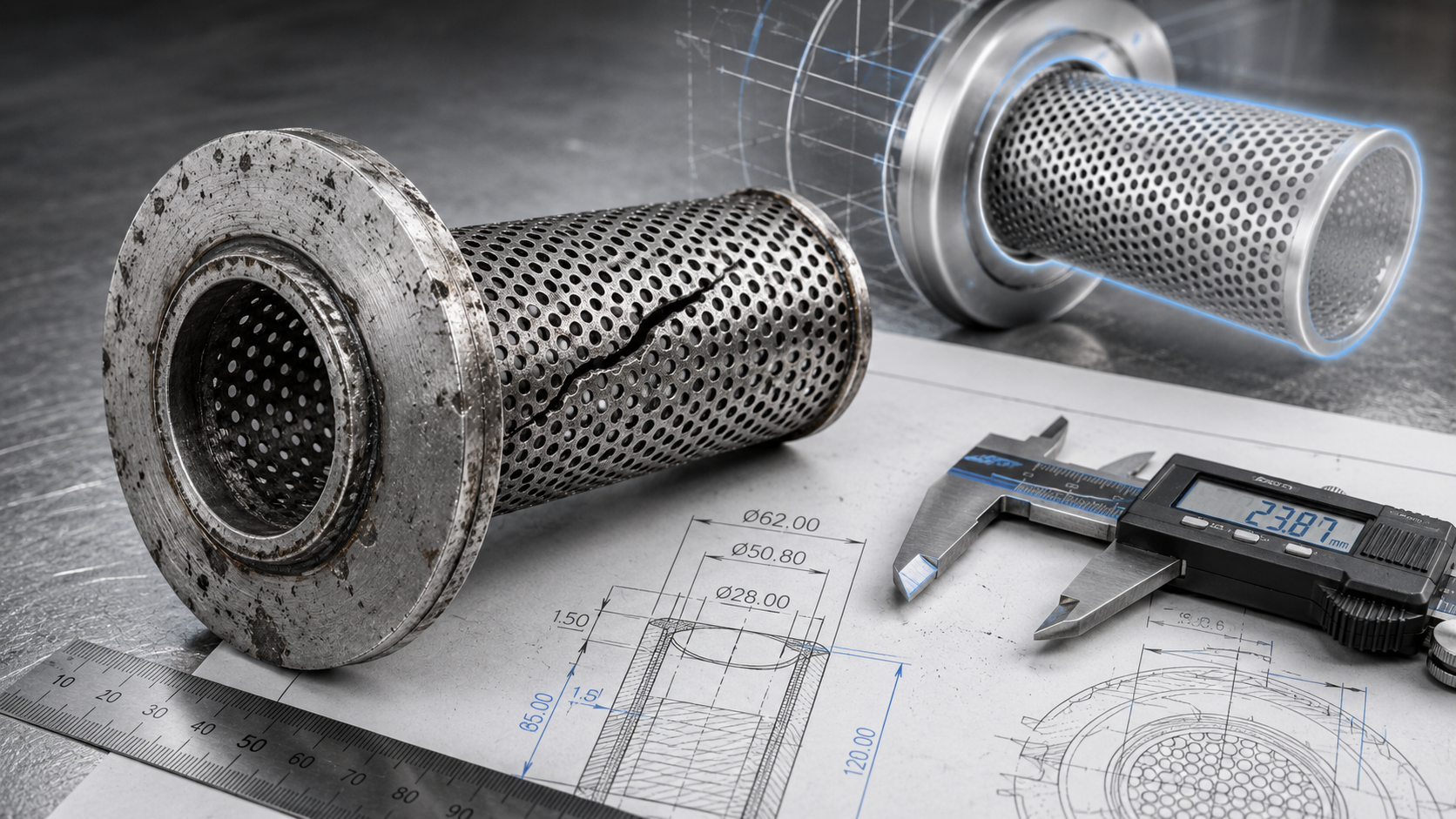
Have an old filter, screen, basket, or perforated tube you can’t easily replace? Before assuming it’s a dead end, learn the seven signs that a worn, obsolete, or hard-to-source filtration component may still contain the clues needed for duplication.
Before you assume an old or damaged component is a dead end, look for these clues.
You have the part in your hand.
Maybe it is worn.
Maybe it is cracked.
Maybe it is clogged.
Maybe it is bent.
Maybe it came out of an older machine, filter housing, analyzer system, process line, or piece of equipment nobody wants to replace.
There is no clear part number.
The original supplier may be gone.
The equipment manufacturer may no longer support it.
The catalog options are close, but not quite right.
The team knows the part matters, but nobody is completely sure what it is called.
So now the question becomes:
Can this part be recreated?
That is one of the most important questions in custom filtration and separation work.
At Western Separations™, we help customers source, duplicate, and manufacture custom filtration and separation components from drawings, samples, CAD files, photos, measurements, and worn parts.
But this article is not just about what we do.
This article is meant to help you look at the part in front of you and understand whether it may be a good candidate for duplication.
Because a worn part is not always a dead end.
Sometimes it is the beginning of the solution.
The Big Light Bulb: A Damaged Part Can Still Contain Good Information
Most people look at an old or damaged component and see a problem.
We see clues.
A damaged screen may still show the original diameter.
A worn basket may still show the shape, connection style, and seam location.
A cracked perforated tube may still show the hole pattern and material thickness.
A bent filter element may still reveal how it fits into the housing.
A failed component may show exactly where the original design was under stress.
That means the old part may still be useful.
It may not be perfect.
It may not be reusable.
It may not even be pretty.
But it may still tell the story.
And if the story is clear enough, the part may be recreated.
That is the key.
You do not always need the original part number to start.
You do not always need the original supplier.
You do not always need a perfect drawing.
You need enough useful information to understand the part’s fit, function, material, openings, and application.
So let’s walk through the seven signs that your part may be a good candidate for duplication.
1. You Have the Physical Part, Even If It Is Damaged
The best clue is often the part itself.
A physical sample can reveal details that are difficult to capture in a description:
Overall shape
Diameter
Length
Wall thickness
Connection points
Weld locations
Opening pattern
Mesh style
End cap design
Flange geometry
Seal surfaces
Wear patterns
Failure points
How the component was originally constructed
Even a damaged sample can be valuable.
If a strainer basket is cracked, it may still show the top ring, sidewall construction, perforation pattern, and bottom connection.
If a screen is worn, it may still show mesh type, size, shape, and how it was attached.
If a perforated tube is bent, it may still reveal the hole pattern, tube diameter, length, and end configuration.
The question is not:
“Is this part still usable?”
The better question is:
“Does this part still show enough information to understand what it used to be?”
If the answer is yes, it may be a good starting point.
Good candidate sign:
You have a sample that can be photographed, measured, reviewed, and used to understand the original component.
2. The Part Has a Clear Shape and Fit
A part is easier to recreate when its physical fit can be understood.
Fit matters because filtration and separation components often live inside larger systems.
A basket may need to sit inside a housing.
A screen may need to seal against a lip.
A tube may need to align with an opening.
A filter element may need to connect to a threaded port.
A custom internal may need to fit inside a vessel or process assembly.
If the part has a clear shape and the team knows where it goes, that is helpful.
Even better, take photos of the part inside the equipment before removal if possible.
That helps answer questions like:
Where does it sit?
Which end faces up?
How does it seal?
Does it slide in, thread in, bolt on, clamp, or rest in place?
Is there a gasket or sealing surface?
Does the component need to be removable for cleaning?
Is there a specific orientation?
Does it connect to another part?
A part that “looks close” but does not fit correctly can create bypass, leakage, vibration, installation problems, flow issues, or premature failure.
That is why fit is one of the first things to understand.
Good candidate sign:
The part’s shape, size, connection points, and location in the system can be measured or explained.
3. The Openings Can Be Measured or Matched
For many filtration and separation components, the openings are the work.
That may mean:
Mesh
Slots
Round holes
Perforations
Wedge wire
Screen openings
Pattern spacing
Open area
Micron rating
Support structure
Media retention features
If the openings can be measured, inspected, photographed, or matched to the original function, the path becomes clearer.
This matters because two parts can look almost identical from across the room but perform very differently in a process.
One screen may allow too much material through.
One basket may restrict flow.
One perforated tube may not provide enough open area.
One mesh element may plug faster than expected.
One support structure may not hold the media correctly.
The opening size and pattern are not just visual details.
They affect performance.
If you know the mesh size, micron rating, perforation diameter, slot width, hole pattern, or open area requirement, include that information.
If you do not know it, that does not automatically stop the project.
A sample, photos, measurements, and application details may still help start the review.
Good candidate sign:
The mesh, holes, slots, perforations, or filtration surface can be measured, photographed, described, or compared to the original need.
4. The Material Can Be Identified or Reasonably Specified
Material matters.
A component may need to handle:
Water
Oil
Steam
Chemicals
Food product
Gas
Air
Abrasive material
High temperature
High pressure
Washdown
Cleaning cycles
Corrosion risk
Sanitary requirements
Repeated installation and removal
Many custom filtration and separation components are made from stainless steel or other performance-grade metals because they need strength, cleanability, corrosion resistance, or durability.
If you know the material, that is valuable.
If you do not know the material, the application can help point the conversation in the right direction.
For example:
A part used in a wet process may need corrosion resistance.
A part used in a food or beverage environment may need cleanability.
A part used in a chemical process may need compatibility with the process media.
A part used in a high-temperature application may need material suitable for heat.
A part that failed from corrosion may need material review before simply duplicating the original.
Sometimes the goal is to match the existing part exactly.
Other times, the failure tells us the material may need to be reconsidered.
The best replacement is not always just a copy of the old part.
The best replacement is the part that fits the application.
Good candidate sign:
The material is known, can be tested, can be specified, or can be reviewed based on the operating environment.
5. The Part’s Job Is Understood
A part is much easier to recreate when its job is clear.
What does it do?
Does it catch debris?
Protect a pump?
Support filter media?
Control flow?
Separate particles?
Protect an analyzer?
Prevent downstream damage?
Help keep a product stream clean?
Fit into a larger filtration or separation assembly?
This is where many requests get stronger.
A customer may not know the technical name of the part, but they may know exactly what it does.
That is useful.
A simple explanation can help:
“This basket catches debris before the pump.”
“This screen sits inside a process line and keeps solids from moving downstream.”
“This perforated tube supports media inside the vessel.”
“This filter element protects an analyzer from fine particles.”
“This part is removed, cleaned, and reused during maintenance.”
That kind of application context matters.
It helps clarify whether the part needs strength, open area, corrosion resistance, fine filtration, easy cleaning, exact fit, or repeatability.
The name of the part is helpful.
The job of the part is essential.
Good candidate sign:
Your team can explain what the component does, what flows through it, and what happens if it fails.
6. The Failure Point Can Be Seen
Failure is not just bad news.
Failure is information.
A cracked weld may show stress or vibration.
A crushed screen may point to pressure or poor support.
A corroded surface may point to material compatibility.
A plugged element may point to particle load or opening size.
A worn edge may point to movement or poor fit.
A broken connection may show where the part needs reinforcement.
Repeated failure may show that the original design should be reviewed, not simply repeated.
If the old part failed, do not hide that.
Photograph it.
Show the crack.
Show the corrosion.
Show the plugged area.
Show the broken seam.
Show the bent section.
Show the point of wear.
That damage may help clarify what the next part needs to survive.
Sometimes the customer thinks, “This part is too damaged to be useful.”
But in many cases, the damaged area is one of the most useful clues.
It tells the story of what happened in the real world.
And the real world is where the replacement has to perform.
Good candidate sign:
The damaged area can be seen, photographed, and explained so the replacement can be reviewed with the failure in mind.
7. You Need a Reliable Replacement Path, Not Just a One-Time Guess
A part becomes a stronger duplication candidate when it is not only a one-time curiosity.
It matters more when the customer needs a reliable path forward.
That may mean:
You need one replacement now.
You need a spare on the shelf.
You need a small run.
You need repeat production.
You need to support older equipment.
You need to avoid sourcing uncertainty next time.
You need a supplier who can understand the application.
You need a documented replacement source for future orders.
This is especially important for maintenance, procurement, engineering, and operations teams.
The first order may solve the immediate problem.
But the real win is often bigger than that.
It creates a replacement path.
The next time the part is needed, the team is not starting over.
They know what the part is.
They know who can review it.
They know what information to send.
They know the quote path.
They know whether the component can be made again.
That is the shift.
From panic to process.
From mystery to documentation.
From one-off scramble to long-term support.
Good candidate sign:
The part matters enough that your team wants a dependable way to replace it again in the future.
The Recreateability Test
Here is a simple way to look at the part in front of you.
Ask these seven questions:
Do we have the physical part, sample, drawing, CAD file, photo, or measurements?
Can we understand how it fits into the system?
Can the openings, mesh, holes, slots, or perforations be measured or reviewed?
Do we know the material, or can we explain the environment it operates in?
Do we understand what the part does?
Can we see how or why the old part failed?
Would having a reliable replacement path help our team avoid future problems?
If you answered yes to several of these, the part may be worth reviewing.
It does not mean every part can or should be recreated.
But it does mean you may not be stuck.
And if the part is critical to your process, that review could be well worth it.
What If You Do Not Have Everything?
That is normal.
Many customers do not have perfect information.
You may not have a part number.
You may not have a drawing.
You may not know the material.
You may not know the original supplier.
You may not know the exact mesh or micron rating.
You may not know the correct technical name.
That does not mean the conversation cannot start.
Send what you have.
A physical sample.
A worn part.
A photo.
A sketch.
A CAD file.
A PDF drawing.
A scanned drawing.
A measurement.
A description of the application.
A note about how the old part failed.
Sometimes the first step is not a final answer.
The first step is review.
The goal is to determine whether there is enough information to move forward and what details need to be clarified.
That is why a clear, practical conversation matters.
What Types of Parts Are Often Worth Reviewing?
Western Separations works with custom filtration and separation components across a wide range of industrial needs.
Parts worth reviewing may include:
Stainless steel screens
Strainer baskets
Filter baskets
Perforated tubes
Slotted tubes
Mesh filter elements
Analyzer filtration components
Instrument protection filters
Process internals
Media support components
Custom housings
Diffusers
Nozzles
Cones
Venturis
Custom metal components
Obsolete filtration parts
Private-labeled replacement components
Hard-to-source separation parts
Short-run or one-off replacement parts
If the part is tied to filtration, separation, media support, fluid flow, air or gas separation, analyzer protection, process support, or equipment protection, it may be a fit for review.
When a Part May Not Be a Fit
A trustworthy supplier should be willing to say when something may not be the right fit.
Not every request is a good duplication project.
A part may not be a fit if:
There is no sample, drawing, photo, measurement, or usable information.
The application requirements are unknown and cannot be clarified.
The part requires certifications or regulatory documentation that are not available.
The required material or tolerance cannot be confirmed.
The customer needs a commodity catalog item faster or cheaper than a custom path makes sense.
The part is outside the company’s manufacturing capabilities.
The risk of recreating it without enough information is too high.
That honesty matters.
The goal is not to force every request into a quote.
The goal is to find the right path.
Sometimes that path is duplication.
Sometimes it is a new custom component.
Sometimes it is gathering more information first.
Sometimes it is confirming that the job is not the right fit.
A strong partner helps you understand the difference.
A Simple Example: The Unknown Basket
Imagine a manufacturer has an older stainless steel filter basket.
The basket sits inside a housing before a pump.
It catches debris from process water.
The top ring helps it seat correctly.
The sides are perforated.
The bottom is reinforced.
It gets removed and cleaned regularly.
The original supplier is unknown.
There is no active part number.
The current basket is cracked near the seam.
At first, that sounds like a problem.
But now look at the clues:
The physical part exists.
The shape is clear.
The fit can be measured.
The perforations can be reviewed.
The material is likely stainless steel.
The function is known.
The failure point is visible.
The customer needs a replacement and probably a spare.
That is a strong candidate for review.
The part is not a mystery anymore.
It is a story with enough information to begin.
A Simple Example: The Perforated Tube Nobody Can Find
Now imagine a process system uses a perforated metal tube inside an assembly.
The tube is not in any current catalog.
The OEM no longer supports the equipment.
The old tube is worn but mostly intact.
The customer has no drawing.
The part needs to support media and allow flow.
The tube length, diameter, wall thickness, and hole pattern can be measured.
The application environment is known.
Again, this may be a good candidate.
Not because the part number exists.
But because the important clues exist.
That is the point.
The supply path may be gone, but the replacement path may still be possible.
Why This Matters to Purchasing, Maintenance, Engineering, and Operations
Custom filtration and separation parts usually sit at the intersection of several teams.
Maintenance knows where the part lives.
Engineering understands the function.
Purchasing deals with the sourcing challenge.
Operations feels the pain when the line is slowed or stopped.
Quality may care about what passes through the system.
Leadership cares about downtime, repeatability, and reliability.
When a part is hard to identify, everyone feels the uncertainty.
A good duplication process helps turn scattered information into a clear review.
Instead of:
“We need this weird old part and nobody knows where to get it.”
The team can say:
“We have a worn sample. It fits this housing. It filters this stream. These are the measurements. This is where it failed. We need one replacement and two spares.”
That is a much better starting point.
That is how a vague problem becomes a real project.
What to Send for Review
If you think your part may be a good duplication candidate, send whatever you have available.
Helpful items include:
Photos from multiple angles
A physical sample
A worn or damaged component
CAD files
PDF drawings
Scanned drawings
Basic measurements
Material information
Quantity needed
Application notes
Operating conditions
Failure photos
Urgency or target timeline
The more useful information you provide, the easier it is to review the request.
But do not wait for everything to be perfect.
If the part matters, start the conversation.
The Part in Your Hand May Be Enough to Start
Here is the main thing to remember:
A part does not need to be perfect to be useful.
An old component may still show the shape.
A damaged component may still show the fit.
A worn component may still show the material and opening pattern.
A failed component may still show what the next version needs to withstand.
Before you assume the part is a dead end, ask whether it still contains the clues needed to recreate it.
That question may save time, reduce uncertainty, and help create a replacement path before the next emergency.
Ready to Find Out If Your Part Can Be Recreated?
If you have a filter, screen, basket, tube, housing, analyzer component, process internal, or custom separation part that is worn, obsolete, hard to find, or difficult to identify, Western Separations can help review it.
Send us your drawing, sample, CAD file, photo, measurements, or worn component.
We will help determine whether the part is a good candidate for duplication, replacement, or custom manufacturing.
Have the part but not all the answers?
That is okay.
Start with what you have.

Precision Tolerances in Filtration: Why Microns Matter More Than You Think
Western Separations™ Resource Series
In filtration, the difference between success and failure can be measured in microns. Whether you’re filtering air, liquid, or gas, the tolerances of your filtration components directly impact performance, efficiency, and lifespan. For critical systems, getting it “close enough” isn’t good enough—precision tolerances are the difference between peak operation and costly downtime.
At Western Separations™, we’ve seen how micron-level precision affects everything from pharmaceutical sterility to aerospace fuel system reliability. Here’s why tolerances deserve your full attention:
Western Separations™ Resource Series
In filtration, the difference between success and failure can be measured in microns. Whether you’re filtering air, liquid, or gas, the tolerances of your filtration components directly impact performance, efficiency, and lifespan. For critical systems, getting it “close enough” isn’t good enough—precision tolerances are the difference between peak operation and costly downtime.
At Western Separations™, we’ve seen how micron-level precision affects everything from pharmaceutical sterility to aerospace fuel system reliability. Here’s why tolerances deserve your full attention:
1. What "Precision" Really Means in Filtration
A micron (μm) is one-millionth of a meter. For context:
Human hair diameter: ~70 μm
Bacteria: ~1–10 μm
Some industrial contaminants: <1 μm
When your system requires separation at a certain micron rating, the actual tolerance (plus or minus variance) determines whether you’re getting consistent results or risking breakthrough.
2. The Cost of Loose Tolerances
Even small inconsistencies can lead to:
Premature fouling – larger particles slip through, overloading downstream filters.
System contamination – critical in food, pharma, or semiconductor processes.
Higher maintenance costs – reduced filter life means more replacements and labor.
Product quality issues – contamination that forces rework, scrap, or recalls.
3. Materials + Tolerances = Reliability
Material choice is only half the battle—manufacturing accuracy seals the deal. Whether we’re working in stainless steel, titanium, Inconel, or Hastelloy, we hold tolerances to exacting standards to ensure predictable, repeatable performance in the field.
4. When Microns Meet Real-World Conditions
Environmental factors like pressure, temperature, vibration, and chemical exposure can shift tolerances over time. That’s why Western Separations™ designs not just for initial precision, but for long-term stability under operating conditions.
5. How We Deliver Precision at Scale
Custom fabrication for unique applications
Tight process control from prototype to production
Verification & testing to ensure every part meets spec
Documentation for regulated industries
Bottom Line:
In filtration, every micron counts. If your current supplier can’t back up their tolerances with testing and proof, you’re gambling with your system’s performance. At Western Separations™, we don’t just promise precision—we prove it.
Ready to tighten up your tolerances?
We design, fabricate, and deliver precision filtration components built to spec, built to perform.
📞 Call Us: +1-502-518-3334
📧 Email: info@westernseparations.com
📄 Request a Quote